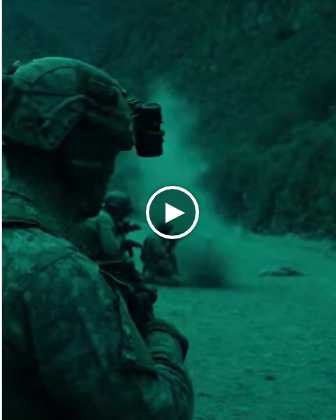
The second round hit the ground at his feet, carving a perfect furrow in the dust that didn’t hit a single man—just drew a straight, impossible line toward the only safe gap in the canyon. “Sir… look at the dust trail,” one of the SEALs whispered. “She’s not missing. She’s pointing.”
And that was the moment they stopped seeing her as a mute liability and started realizing she was the only one who could see the whole damn battlefield.
Kalin squints into the dust, stunned. The trail is too precise to be luck. The next round cracks, this time ten feet farther, directly along the line—like breadcrumbs made of pure tungsten. One by one, the SEALs begin to follow it, sprinting low, weaving between rocks, trusting the whisper of steel more than the voice in their ears.
Aara doesn’t blink. Her cheek stays glued to the stock, her breathing steady. Every five seconds, another shot—always in line, never hitting a soul. She’s speaking with bullets, carving a path like a lighthouse in a storm. And just behind her, nestled into the folds of jagged black stone, her spotter board glows faintly with scribbled wind notes, range estimates, corrections, all written with grease pencil in shorthand only she understands.
Below, Kalin dives behind a boulder as enemy fire thickens again. “Who the hell are they aiming at?”
“Not us, sir,” murmurs Miller. “They’re targeting her.”
He’s right. Tracer rounds arc skyward now, hunting her muzzle flash. Her shots are giving away her position—but they’re also keeping the team alive.
“Sniper element, hold fire!” Kalin barks out of habit. But this time, no one listens. Especially not Aara.
She’s already shifted two feet left, slithered into a new shadow, cycled the bolt. Another round screams out. The red tracer that had been searching for her hits only cold stone.
A breath. Then another shot.
Down below, the team makes it to a curve in the wadi wall. They’re safe—for ten seconds.
Then the canyon trembles with a new sound: the deep, throat-rattling thump of an enemy mortar tube.
Aara hears it too.
She yanks her scope off the ridge and scans left. A flicker—movement behind a sun-bleached adobe ruin. A finger wiping dust from a lens. A shimmer of heat.
Got you.
She shifts, dials, clicks—wind, range, drop—and fires before the mortar round even leaves the tube.
A second later, a puff of black smoke erupts from the compound. The mortar doesn’t fire. It never will.
But the echo of that shot gives her away.
The ridgeline explodes in retaliation. RPGs whistle overhead, machine guns spit fire. Rounds hammer her position, snapping into rocks, kicking up shards that slice across her cheek. She doesn’t flinch.
Instead, she starts drawing again—this time with bullets that don’t just point, but speak.
One hits the rooftop near the northern ridge, causing three hidden fighters to duck. A second hits the edge of a shadow, and a third snaps into the dirt a foot from a cave opening. Each round is a sentence. A sentence written in steel, saying: “They’re there.”
Kalin sees it.
“She’s painting them,” he mutters. “She’s marking targets.”
“Sir,” Miller says, eyes wide, “she’s building a damn target package. With a bolt-action.”
The radio crackles again. “This is Falcon Three inbound, twenty seconds out with fast movers. Need coordinates. I repeat, need coordinates.”
Kalin stares at the ridgeline. No laser. No GPS. Just Aara.
And those damn bullet trails.
He grits his teeth. “Use her impacts. Copy her fire. That’s your target grid.”
“Roger that. Danger close confirmed.”
Above the canyon, two F-16s shriek into the valley like vengeful gods.
Aara doesn’t stop. She fires again and again, guiding them to each nest, each hide, each rooftop. Her hands bleed, her breath fogs in the cold, but she holds.
She paints death in arcs of copper.
The jets roar over, dropping precision munitions like divine punctuation marks. The ridge vanishes in a blossom of flame. The rooftops collapse under concussive fury. And then… silence.
Not the tense kind, but the total kind.
The kind that means it’s over.
Kalin’s voice comes through the static, stunned. “Sniper, cease fire.”
But Aara’s already lowering the rifle.
She wipes the blood from her cheek, blinking through sweat and grit. Her hands tremble—not from fear, but from the recoil of carrying an entire platoon’s survival on her back.
Minutes pass. Then a voice behind her.
“You disobeyed a direct order.”
It’s Kalin. His boots crunch over loose shale as he approaches.
She doesn’t move.
“You revealed your position. Took command. Called an airstrike with bullet holes.”
A pause.
“You saved all of us.”
She looks up at him, her eyes unreadable.
He exhales. “I don’t know how the hell we write that up in the after-action.”
She pulls out her notepad. Slowly scribbles a single sentence.
Then turns it around.
It reads: “Just write: I spoke when no one else could.”
He chuckles, a dry sound. “That’s going in the report.”
She nods once and begins packing her rifle. It’s methodical, reverent, the way a surgeon might close up after a patient pulls through.
When they return to base, the mood is different.
No one laughs at her anymore.
They don’t need to. They’ve seen what she says when it counts.
In the debriefing, the commanders sit behind glass, staring at a playback of satellite footage. A single line of dust, carved perfectly into the sand, like a trail of breadcrumbs. Then the airstrike. Then the silence.
Colonel Myers clears his throat. “Lieutenant Kalin, did the sniper operate within mission parameters?”
Kalin shifts. “No, sir.”
“You said she was a liability.”
“I was wrong, sir.”
The colonel’s eyes narrow. “And how exactly did she communicate these enemy positions?”
Kalin glances at Aara, who sits silently at the back of the room.
“With poetry,” he says. “Written in gunpowder.”
There’s a silence. Then the colonel leans back and murmurs, “She’ll need a commendation. Maybe more.”
A week later, she gets it.
But it’s not the ribbon that matters. Not the medal. Not even the grudging respect.
It’s the note Kalin leaves on her cot.
Six words, scribbled in Sharpie on a torn ration box:
“Next op, you call the shots.”
And when that op comes—three nights later, in another valley, another ridge, another hellhole where ghosts crawl through the rocks in the dark—it’s Aara’s bullet that speaks first.
This time, no one tells her to hold fire.
This time, the comms officer is silent—because all ears are tuned to her voice, the one that doesn’t need sound.
She fires once.
And the entire platoon moves.
Like one body.
Like they’ve known all along.
That in war, some orders come loud.
But the ones that save you… come silent.